
Product Overview
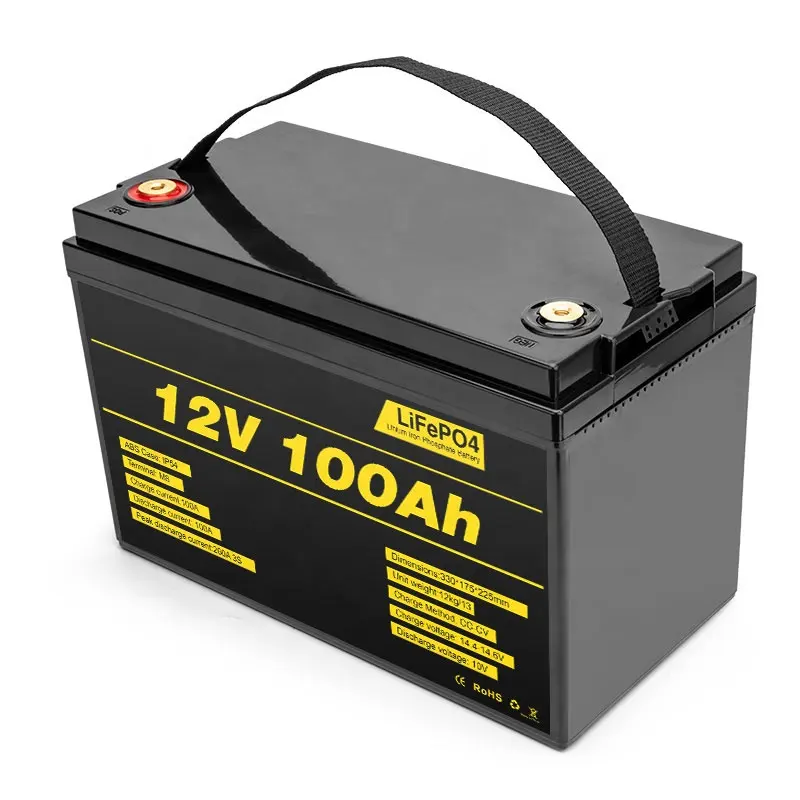
The 12V 100Ah deep-cycle LiFePO4 battery is the workhorse of 12V mobile and off-grid power — equally at home in an RV, on a boat, or paired with solar. Nominal energy is 1,280Wh (12.8V × 100Ah). Usable energy depends on the BMS low-voltage cutoff and depth of discharge: at 80% DoD it delivers roughly 1,024Wh of usable energy per cycle.
As a China-based LiFePO4 battery supplier and OEM/ODM solutions provider, we supply this configuration for wholesale, private label, and custom projects. Specifications below reflect commonly available configurations; final specifications are confirmed per order.
- Drop-in 12V replacement: typical footprint aligns with Group 27 battery boxes — verify your tray dimensions before ordering (see Compatibility).
- Deep-cycle design: 3,000+ cycles at 80% DoD under standard test conditions (25°C).
- Built-in BMS: over-charge, over-discharge, over-current, short-circuit and temperature protection (typical).
- B2B ready: wholesale pricing, OEM branding, ODM configuration and sample orders supported.
Nominal vs usable energy — read the label correctly. 1,280Wh is the nominal energy (12.8V × 100Ah). What you can actually draw per cycle is the usable energy: ≈1,024Wh at 80% DoD, up to ≈1,280Wh at 100% DoD (shallower cycling extends life — see our cycle life vs depth of discharge guide). Compare suppliers on usable energy at a stated DoD, not on nominal watt-hours alone.
Technical Specifications
Each parameter is marked Typical (commonly available configuration), Optional (available on request), or To Be Confirmed (confirmed against the datasheet for your order). Nothing below should be read as a guarantee for any specific unit — always confirm against the order datasheet.
| Group | Parameter | Value | Status |
|---|---|---|---|
| Electrical | Chemistry / configuration | LiFePO4, 4S | Typical |
| Nominal voltage | 12.8V (12V class) | Typical | |
| Rated capacity | 100Ah | Typical | |
| Nominal energy | 1,280Wh | Typical | |
| Usable energy (80% DoD) | ≈1,024Wh | Typical | |
| Mechanical | Dimensions (L×W×H) | ≈330 × 172 × 225 mm (Group 27 footprint class) | Typical |
| Weight | ≈12 kg | Typical | |
| Terminals | M8 threaded terminals (typical); other terminal types | Typical / Optional | |
| Enclosure | ABS case, carry handle (typical) | Typical | |
| BMS protection | Continuous discharge current | 100A typical (higher-current BMS on request) | Typical / Optional |
| Protections | Over-charge, over-discharge, over-current, short-circuit, over-temperature | Typical | |
| Low-temperature charge protection | Optional (recommended for cold climates) | Optional | |
| Charging | Charge voltage (absorption) | 14.2–14.6V | Typical |
| Recommended charge current | 20–50A (0.2–0.5C) | Typical | |
| Charger requirement | LiFePO4-profile charger or MPPT with lithium setting | Typical | |
| Discharging | Discharge cut-off voltage | ≈10.0V (BMS dependent) | Typical |
| Peak discharge | 200A for ≤3 s (typical) | Typical | |
| Environmental | Charge temperature | 0°C to 45°C (do not charge below 0°C unless low-temp protection fitted) | Typical |
| Discharge temperature | −20°C to 60°C (typical) | Typical | |
| Self-discharge | <3% per month at 25°C | Typical | |
| Cycle life | Cycle life @ 80% DoD, 25°C | 3,000+ cycles (standard test conditions) | Typical |
| Calendar life | 8–12 years in typical RV/marine service | Typical | |
| Docs | Datasheet, UN38.3, MSDS, certifications | Coordinated per order — request the current document package | To Be Confirmed |
Compatibility & Applications
Group 24 / Group 27 replacement
The typical footprint (≈330 × 172 × 225 mm) aligns with the Group 27 battery box class, and the ≈12 kg weight is roughly one-third of an equivalent lead-acid unit. Before ordering, measure your battery tray/box: Group 24 boxes (≈260 mm long) will not fit this size — confirm the Group 27 (or larger) compartment, terminal orientation, and hold-down method.
Where it fits
- RV & camper vans: house battery for lights, water pump, vent fans and small inverters (≤1,200W continuous on a 100A BMS — size the inverter to the BMS, not just the capacity). Most RV converters need a lithium charge profile (14.2–14.6V absorption). See our RV dealer buying guide.
- Marine: house battery for day boats and sailboats. No acid spill risk, vibration-tolerant construction; charge from alternator via a DC-DC charger or from solar via MPPT.
- Solar & off-grid: pairs with MPPT controllers set to a LiFePO4 profile. For array/battery sizing, use our solar battery sizing calculator.
- Trolling motors & camping: flat 12.8–13.2V discharge curve keeps motors and 12V appliances running at full performance deep into the cycle.
Charging & Compatibility
Use a LiFePO4-compatible charger: bulk/absorption 14.2–14.6V, no equalization/desulfation stage. Standard lead-acid chargers may undercharge the battery or trigger BMS protection — see how to charge LiFePO4 batteries and the charging voltage chart.
- AC chargers: select the LiFePO4 / lithium profile; 20–50A recommended for 100Ah.
- Solar MPPT: set absorption 14.2–14.4V, float 13.6V (or disable float per controller manual).
- Alternator charging: use a DC-DC charger with lithium profile — never connect directly to an unregulated alternator.
- Series/parallel: limits depend on the BMS configuration — confirm max series/parallel count for your order before connecting multiple units.
Lifespan & Safety
Cycle life: 3,000+ full-equivalent cycles at 80% DoD, 25°C, under standard test conditions. Real-world service life in RV/marine use is typically 8–12 years; shallower cycling and moderate temperatures extend it, while sustained heat, routine 100% DoD cycling, and chronic over-charging shorten it. Learn how depth of discharge shapes cycle life and whether to charge to 100%.
Safety: LiFePO4 chemistry is thermally stable with a high thermal-runaway onset temperature compared with other lithium-ion chemistries — but no battery is zero-risk. Safe service depends on the BMS protections, correct charger voltage, proper fusing and wiring, and installation away from heat sources. See our battery safety hub. When evaluating any supplier’s cycle-life claims, use our verification checklist.
Wholesale, OEM & ODM
We support distributors, wholesalers, installers and energy storage brands with flexible cooperation models. New to battery importing? Start with our MOQ and sample order guide, then see the wholesale buyer’s guide for sourcing from China step by step.
- Wholesale: volume pricing for distributors and resellers; terms vary by configuration and order size — contact us with your volume requirements.
- OEM branding: custom enclosure, logo, labeling and packaging for your brand.
- ODM configuration: capacity, BMS features, terminals, communication and low-temperature options matched to your application.
- Sample orders: sample and trial orders welcome for evaluation before volume commitment.
- Documentation support: datasheets, UN38.3/MSDS and market-specific files coordinated per order — request the current document package.
What Affects the Quote for the 12V 100Ah
We do not publish a fixed price for this model, because the same 12.8V 100Ah can be quoted in several configurations. These are the items that move a quotation, so you can compare two suppliers like for like. Nothing here is a price, a minimum order quantity or a lead time; those are confirmed in the quotation for your configuration.
| Group | Parameter | Value | Status |
|---|---|---|---|
| Cells | Cell grade, brand and batch documents | Changes the cost and the cycle-life expectation; the grade and cell maker are stated in writing per order (see the Grade A vs Grade B guide) | [Confirmed per project] |
| BMS | Continuous current, Bluetooth, low-temperature charge protection, communication | The table above shows 100A continuous as typical; a higher-current or communicating BMS is a different configuration | [Optional configuration] |
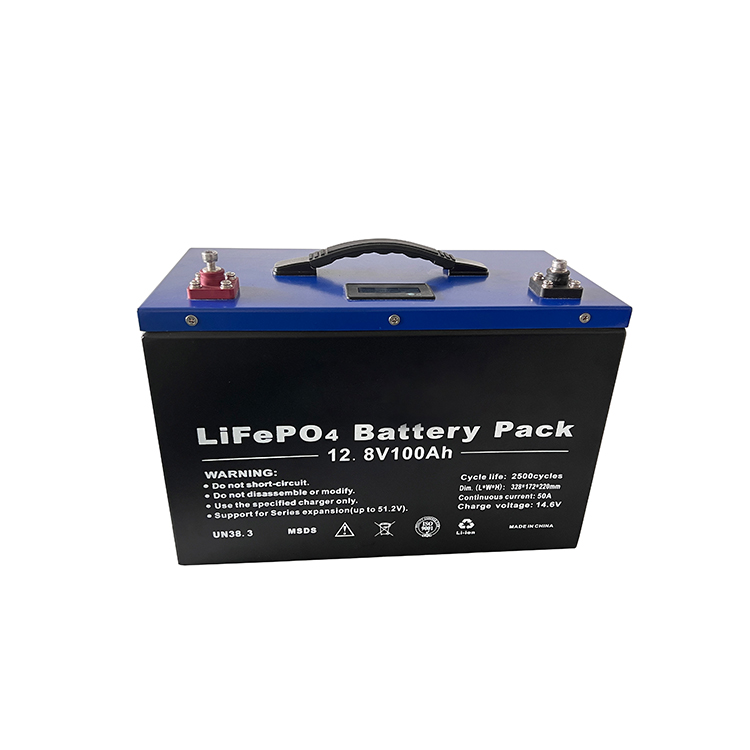
| Enclosure | Case, terminals, handle, colour, Group 27 footprint class | Standard case as shown, or a customer-specified housing (a new housing is a development item) | [Optional configuration] |
| Branding | Logo, labels, packaging and manuals | Standard labelling, your own logo, or your own packaging | [Optional configuration] · [Confirmed per project] |
| Quantity | Order stage and volume per model | Sample, trial order or repeat order; quantity tiers are confirmed in the quotation | [Confirmed per project] |
| Trade terms | Incoterm, port and payment | Standard payment is bank transfer (T/T); the Incoterm and port you want quoted are confirmed per order | [Confirmed per project] |
| Documents | Datasheet, UN38.3 test summary, SDS, certificates or test reports your market asks for | Which documents exist for this exact model and destination is confirmed before you commit; none is assumed | [Confirmed per project] |
| Destination | Country, port and any market-specific label or import requirement | Affects the document set, the labels and the shipping method | [Confirmed per project] |
What to send with your inquiry
- Model and quantity: 12V-100Ah (pre-filled when you use the button below), the quantity, and whether this is a sample, a trial order or a repeat order.
- Application and system: RV, marine or solar; the charger, converter or inverter model; the highest continuous load in amps; how many batteries will be connected in parallel or series.
- Options: BMS current rating, Bluetooth, low-temperature charge protection, terminal type, case or footprint limits.
- Branding: standard labelling, your logo, or your own packaging.
- Documents: the files your customs broker, retailer or insurer asks for.
- Delivery: destination country and port, the Incoterm you want quoted, and your target timing.
You can also reach us on WhatsApp: +1 404 784 1946 (primary), +86 159 8945 0735 (backup), or email jack@ljyenergy.com. To compare quotes line by line, see the wholesale buyer’s guide and the MOQ and sample order guide.
Frequently Asked Questions
What is the difference between nominal and usable energy?
Nominal energy is 1,280Wh (12.8V × 100Ah) — the nameplate figure. Usable energy is what you can draw per cycle: about 1,024Wh at 80% depth of discharge, up to the full 1,280Wh at 100% DoD. Shallower cycling extends cycle life, so most system designs work around 80% DoD.
Will it fit my Group 24 or Group 27 battery box?
The typical footprint (≈330 × 172 × 225 mm) matches the Group 27 class. It will not fit a Group 24 box (≈260 mm long). Measure your tray, check terminal orientation and the hold-down method before ordering.
Can I replace my RV’s lead-acid battery directly?
In most cases yes, provided the compartment fits and your charger/converter has a lithium profile (14.2–14.6V absorption). Lead-acid chargers with equalization stages should not be used. Also verify that your inverter’s continuous draw stays within the BMS discharge rating.
How long will the battery last?
3,000+ cycles at 80% DoD under standard test conditions (25°C); 8–12 years is typical in RV/marine service. Actual life depends on charge practices, temperature, depth of discharge and cell quality — see our Grade A vs Grade B cells guide.
Do you offer wholesale pricing and samples?
Yes. We work with distributors and resellers — contact us with your volume requirements for a quotation. Sample and trial orders are welcome for evaluation. We do not publish fixed wholesale prices because terms vary by configuration and volume.
Can I get custom branding or a different configuration?
Yes. OEM private labeling (enclosure, logo, packaging) and ODM configuration (capacity, BMS features, terminals, low-temperature protection) are available per project. See our OEM/ODM page for the process.
Technical Resources
- LiFePO4 battery charging guide — methods, voltages and troubleshooting
- Charging voltage chart — absorption/float targets by system voltage
- Cycle life vs depth of discharge — how DoD shapes lifetime
- Battery safety hub — handling, installation and thermal safety
- How to verify cycle-life claims — procurement checklist
- LiFePO4 vs lead-acid — total-cost comparison for buyers