
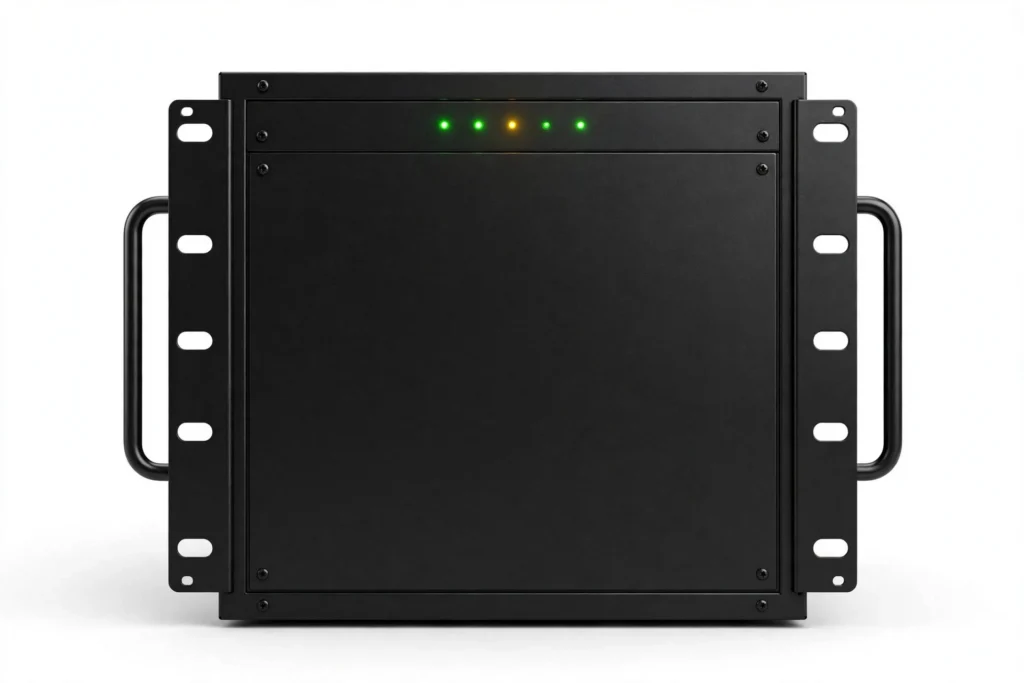
48V 100Ah LiFePO4 Energy Storage Battery
Product Overview
The LJY Energy 48V 100Ah LiFePO4 battery is a 5kWh energy storage module designed for residential solar, commercial energy storage and off-grid power systems. Built on lithium iron phosphate (LiFePO4) chemistry, it gives distributors and installers a safe, dependable building block — from a single 5kWh module up to 10kWh and 20kWh system configurations.
The modular approach is the point: stock one SKU and configure systems by paralleling modules, instead of warehousing a different battery for every project size. The 48V-class voltage matches the mainstream residential and light-commercial inverter ecosystem. As a China-based LiFePO4 battery supplier and OEM/ODM solutions provider, LJY Energy configures module capacity, BMS, communication and branding to your project requirements.
Typical Specifications
Values below are typical configurations. “Optional” items can be specified per order; “To be confirmed” items depend on the final configuration and order — contact us for the datasheet of the exact build you need.
| Parameter | Value | Status |
|---|---|---|
| Battery chemistry | LiFePO4 (lithium iron phosphate) | Typical |
| Nominal voltage | 48V class | Typical |
| Rated capacity | 100Ah per module | Typical |
| Energy | 5kWh per module | Typical |
| System configurations | 10kWh / 20kWh via parallel modules | Typical |
| Charge voltage (bulk/absorption) | Per system voltage — see charging voltage chart | Typical |
| Built-in BMS | Over-charge / over-discharge / over-current / short-circuit / temperature protection | Typical |
| Communication | CAN / RS485 for inverter closed-loop communication | Optional |
| Bluetooth / app monitoring | Cell voltages, SOC, temperature on mobile app | Optional |
| Low-temperature heating | Self-heating pad for sub-zero charging environments | Optional |
| Rack / enclosure options | Rack-mount, wall-mount or floor-standing enclosure | Optional — OEM/ODM |
| Capacity options | 200Ah / 400Ah modules | Optional — subject to configuration |
| Certifications | UN38.3 / MSDS / CE and others per target market | To be confirmed per order |
| Warranty terms | Subject to configuration and order agreement | To be confirmed |
| Dimensions & weight | Per final enclosure design | To be confirmed — datasheet on request |
| Lead time | Subject to order quantity and configuration | To be confirmed |
Why LiFePO4 for Energy Storage
For stationary storage, the buying criteria are cycle life, safety and lifetime cost per delivered kWh — exactly where LiFePO4 leads. Thousands of deep cycles versus hundreds for lead-acid, no cobalt or nickel supply exposure, and a thermally stable cathode that does not release oxygen during decomposition. Our LiFePO4 vs lead-acid B2B comparison works through the 10-year TCO math, and the battery safety guide explains the system-level safety picture.
Charging & Compatibility
Set the charger or inverter to the LiFePO4 profile for your system voltage — bulk/absorption per our charging voltage reference, no float stage, no equalization. The complete charging guide walks through CC/CV operation.
- Solar / MPPT: program absorption to the LiFePO4 setpoint; disable lead-acid equalization routines.
- Hybrid inverters: 48V-class nominal matches mainstream residential hybrids; CAN/RS485 closed-loop communication optional for supported brands.
- Multi-module systems: parallel modules share charge current — verify per-module current limits and use the inverter’s battery communication where available.
- Generator backup: generator AC through the inverter charges the bank; size the charge rate within the BMS continuous-charge limit.
Charging faults are usually configuration, not hardware — our troubleshooting guide covers the diagnostic path. For project charger sizing, see OEM/ODM charging solutions and the charging knowledge hub.
Battery Lifespan
Stationary systems live or die on lifetime throughput. As a typical cell-level reference: around 6,000 cycles at 80% depth of discharge (25°C, to 80% capacity retention); pack-level results depend on BMS, thermal design and duty cycle. Designing around 80% DoD roughly doubles cycle life versus 100% DoD — the DoD vs cycle life guide shows the economics. Practical charge strategy: daily 80–90% with periodic full charges for BMS recalibration (see should you charge to 100%).
Evaluating supplier cycle-life claims? Our procurement checklist shows what to demand: the five test conditions, the capacity-retention curve, and pack-level (not just cell-level) expectations.
Sizing & Selection
Start from daily kWh throughput and autonomy requirements: a single 5kWh module suits essential-load backup and small solar self-consumption; two modules (10kWh) cover a typical home’s evening load; four modules (20kWh) serve whole-home backup and small commercial use. Size the inverter’s continuous and surge ratings against your peak loads separately from the battery capacity decision. For parallel systems, confirm inter-module communication and the maximum parallel count at the quoting stage.
Applications
- Residential solar energy storage and self-consumption
- Commercial peak-shaving and backup power
- Off-grid homes, cabins and rural electrification
- Telecom base stations and remote monitoring
- Small industrial UPS augmentation
Wholesale, OEM & ODM
Built for the distribution channel: one modular SKU, configurable systems, brandable enclosures. New to battery importing? Our MOQ and sample order guide and wholesale buyer’s guide walk through the process.
- Sample / trial orders: validate quality before volume commitment.
- OEM branding: enclosure, logo, labeling and packaging for your brand.
- ODM configuration: module capacity, BMS features, communication protocols, heating and enclosure matched to your application.
- Documentation support: datasheets, UN38.3/MSDS and market-specific files coordinated per order — request the current document package.
Frequently Asked Questions
How many modules can I parallel?
Parallel expansion is supported subject to configuration — typical systems run 2–4 modules (10–20kWh). Confirm the maximum parallel count for your order at the quoting stage.
Which inverters are compatible?
Mainstream 48V-class hybrid inverters. Check the inverter’s battery voltage window and, where supported, use CAN/RS485 closed-loop communication.
What is the lifespan of this battery?
Depends on depth of discharge, temperature and duty cycle. Quality LiFePO4 cells are typically rated around 6,000 cycles at 80% DoD (cell level). See our lifespan guide for the variables that matter.
Can I use my existing lead-acid charger?
Not recommended — lead-acid equalization/desulfation routines can trigger BMS protection. Use a LiFePO4 charge profile; see the voltage chart.
What certifications are available?
UN38.3, MSDS, CE and others are coordinated per order and target market — contact us for the current document package. Our certifications guide explains what each standard covers.
Do you support OEM/ODM?
Yes — branding, enclosure, BMS configuration and capacity options are supported and confirmed per project for distributors and energy storage brands.
Specifications are typical configurations and subject to the final order specification. Certifications, warranty, dimensions, lead time and pricing are confirmed per inquiry. Content as of October 2026.